Tuesday, 8 May 2012

ve day


It is 65 years ago to the day that Great Britain and the rest of Europe were celebrating the end of the Second World War. A war that had gone on for 6 long years, cost millions of lives, had brought untold hardship and suffering to even more millions of people the like of which we will never know. And for those that had survived it was a time to celebrate and rejoice.

Here in France it is a National Holiday and l believe we should do the same in the UK. It seems fitting to mark this day as an entry on my blog. But as such l know l have to keep it short so l hope l can capture the spirit of the time in the following extracts.

On 4 May 1945 the German forces in north-western Europe surrendered to General Montgomery at Luneberg Heath. On 7 May the German Supreme command surrendered at Rheims. The 8 May was designated as VE-Day – Victory in Europe Day (the war against the Japanese still continued). In Britain there was a great deal of rejoicing and for the first time for many years there was floodlighting of public buildings and statues; restaurants, cinemas and theatres were fully lit up. It was said that some children were terrified by the unexpected amount of light!

The Prime Minister, Winston Churchill, announced to the nation that Germany had, at last, surrendered.
There were scenes of great jubilation, Churchill appeared with the Royal Family on the balcony of Buckingham Palace.He announced to the crowd: “This is your victory. It is the victory of the cause of freedom in every land. In all our long history we have never seen a greater day than this. Everyone, man or woman, has done their best.” The crowds below cheered and sang ‘For he’s a Jolly Good Fellow’ followed by three cheers for victory.
Winston C
hurchill on the balcony of Buckingham Palace with the King and Queen, Princess Margaret and Princess Elizabeth.
VE Day dawned, and for the first time in almost 6 years the weather forecast could be published in the newspapers. ‘Wind freshening; warm and sunny at first but rain can be expected later’, read the Daily Mirror. But the forecast was wrong: ‘the sudden warm snap’ did continue. By the afternoon the temperature in London had risen to 75F and the celebrating crowds sweltered in the unseasonal heat.
Nothing official had been planned to celebrate Victory in Europe. Resentment still simmered in some quarters. ‘A muddle, it was a muddle’. ‘Telling us over and over the church bells would be the signal. And then there was no signal. Just hanging around’. ‘Do ‘em no good in the General Election. The way they have gone on over this. People won’t forget it. An insult that’s what it was…No bells, no All Clears. Nothing to start the people off. That’s what they were afraid of…’ J.G.
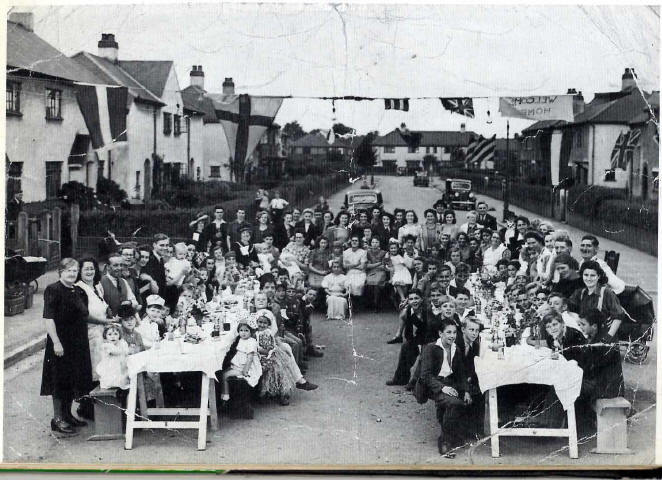
But the people did celebrate and took it upon themselves to organise street parties up and down the land. Neighbours pooled their sweet rations and made cakes and sandwiches. They tore down the black-out curtains and made them into fancy dress for the children, music was played in the streets and many had bonfires with effigies of Hitler on top of them. unsecured loans

The following is from a woman working at W.V.S. headquarters in London and describes the night in a letter to a friend:
We all walked to Buckingham Palace. As we got in front of it the flood-lighting flicked on. It was wonderful…magnificent and inspiring and it seemed we had never seen so beautiful a building. The crowd was everywhere and yet one could walk through it. We edged our way to a good view of the balcony, which was draped with crimson, with a yellow and gold fringe. The crowd was such that l have never seen- l was never so proud of England and our people. It was a crowd of seperate individuals. There was never any mass feeling. Everybody spoke quietly or was silent- everybody looked just relieved and glad. We waited. Coloured rockets went up behind us. Then the King and Queen and two Princessses came onto the balcony. We yelled and yelled and yelled and waved and cheered. They waved back to us. It was wonderful…then we began  to walk.We went to a huge bonfire in the park. People had joined hands and were circling round it. We walked by the lake- there were coloured lights in the trees and bushes reflected in the water. We came out of the Park by the Middlesex Guild Hall. It was floodlit in a warm yellowish light and looked medieval with flags from what looked like the battlements. bad credit loans


We went to Big Ben. It was floodlit and looked magnificent. I heard myself say ‘Dear Big Ben! Dear Big Ben!’ The Houses were floodlit from the river and all the lights along the Terrace. What moved us all beyond anything else was the great Union Jack on the Lords. It, alone, was floodlit by lights going straight upwards. It was a great, lovely Union Jack, flying grandly in the sky by itself…We walked to the middle of Westminster Bridge and stood there. Searchlights were all rotating and making a kaleidoscope pattern all over the sky. County Hall was lit in two colours and the training ships in the river strung with coloured lights…We walked back to Parliament Square and turn ed to face Big Ben. It was a few minutes to midnight…At one minute past, all fighting was to cease. It was absolutely silent. Big Ben struck. Just before the last stroke it had reached one minute past. A great cry went up and people clapped their hands. Something went off with a bang…The tugs in the river gave the V sign. It was unforgettable.

Friday, 4 May 2012

cassinga day in namibia


Let us share with you the basic information you need to know when travelling to Namibia. If there is anything else, please do not hesitate to contact us directly.
 
 
General Information:
Capital: Windhoek
Government: Republic
Area: total 824,292 sq km
Population: 1,973.900 (2004)
 
Languages
English; Afrikaans; German; other languages Oshivambo, Herero and Nama.
English is the official language and travellers should have little difficulty communicating with locals, except in some of the remote rural areas. Prior to independence in 1990, Afrikaans was the official language and it is still the lingua franca; the only exception being the Caprivi region where English is spoken. German is widely spoken in Windhoek, Swakopmund, Luderitz and some of the smaller towns. Oshiwambo is the most widely spoken of Namibia’s indigenous languages.
 
 
Electricity
Electricity of 220 volt AC is supplied and sockets are for round, three pin plugs, and 15 amp types.
 
Public Holidays unsecured loans
The following Public Holidays are observed in Namibia.
New Years Day:                  01 January
Independence Day:              21 March
Good Friday:                       March –April
Easter Monday:                   March- April
Workers Day:                      01 May
Cassinga Day:                     4 May
Ascension Day:                   40 days after Easter
Africa Day:                         25 May
Heroes Day:                       26 August
Human Rights Day:             10 December
Christmas Day:                   25 December
Family Day:                        26 December
 
Climate
With an average rainfall of 270mm per year, Namibia is considered to be an arid country. More than 70 percent of the countries rain is recorded between January and April, the rainfall as well as the length of the rainy season increases from the coast inland from south to north. Rain usually falls in the afternoon in the form of thunderstorms which soon pass.
The months between May and September are considered the best time to visit the interior. Daytime temperatures are pleasant, but the evenings can be cold. The following table will give a good indication of the temperatures throughout the country. The figures given are average figures; please bear in mind that temperatures of over 35 degrees Celsius often occur.
 
 
Health and Personal Safety
Health
Although the country is virtually free of tropical diseases, visitors to the Northern regions must be aware of Malaria and bilharzias.
Tap water in the towns is purified and perfectly drinkable. Water obtained from boreholes is very often brackish and can taste unpleasant but is not generally a health risk. In all instances, especially rural communal areas, caution should be exercised.
 
Personal Safety
Tourists visiting any country are a preferred target and Namibia is no different. Always be on the alert for handbag snatchers and pick-pockets. Exercise caution by keeping your vehicle locked. Do not leave valuables or bags visible in the vehicle. When sightseeing in the towns leave cameras, electronic equipment, tickets, passports and excess cash safely at your hotel. It is recommended that you take out insurance to cover personal effects and medical emergencies.
 
Posts and Telecommunications
The postal service in Namibia is operated by Nampost, a government owned enterprise, with post offices throughout the country. The service offered is efficient and reliable.
Telecommunication services in Namibia are provided by Telecom Namibia, an independent state-owned enterprise with more than 50 offices throughout the country.
Namibia has an excellent telecommunications system, with direct dialling to over 200 international destinations. The international dialling code for overseas calls to Namibia is +264, while area codes in the country are preceded by a 0. When calling from outside of Namibia, the 0 of the area code must be submitted.
 
Coin and card public phones are provided at Post-offices, police stations and public places. Cards are sold at Teleshops and Nampost offices.
 
The cellular network is operated by Mobile Telecommunications Ltd (MTC). The network covers Windhoek and virtually all major towns and their immediate surroundings.
 
Time
Namibia introduced differentiated standard times for summer and winter in 1994. Summer time is two hours ahead of Greenwich Mean Time (GMT+2) and commences at 02:00 on the first Sunday of September, ending 02: 00 on the first Sunday of April the following year. Winter time is one hour in advance of GMT (GMT+1) and commences at 02:00 on the first Sunday in April, ending 02:00 on the first Sunday of September.
Namibian winter time is hence one hour behind South African Standard time. In the Northeast of the country many shops, businesses and offices continue to operate on Namibian summer time, as this region lies much further east than the rest of the country.
 
Water
Water from all Namibia’s taps is suitable for drinking. Water is one of Namibia’s scarcest commodities and as such visitors are earnestly requested to make a meaningful water-saving contribution while in the country.
 
 
Here are some simple measures that can be taken:
Shower instead of bath. An average 10cm bath uses about 80 litres of water, while a short shower uses about 24 litres. bad credit loans
 
If a shower is not available then remember that it is not necessary to fill the bath to the rim. You can also share a bath – its fun.
 
Don’t leave water running while washing your hands, brushing your teeth or shaving, use the plug.
 
Use a glass or keep a container of water in the refrigerator rather than drinking water from the tap or letting it run until it is cold.
 
If you notice a leaking tap, report it to the venue’s host.
 
It is illegal to use a hose pipe to wash your car, use a bucket and cloth instead.
 
Thank you for helping us conserve Namibia’s water.
 
What to pack when visiting Namibia
The temperatures in Namibia are clear indications of the type of clothing required.
During the summer months, for both day and night, light clothing is necessary i.e. Cotton shirts, shorts and skirts. Long sleeved shirts and long cotton trousers are a good idea if your skin is sensitive to the sun; they also help to keep mosquitoes at bay after sunset.
This clothing is also adequate for winter day-wear but for early mornings, evenings and night time, warm trousers, jerseys, tracksuits, balaclava, gloves and warm socks may be needed.
Do not forget your sunhat, sunscreen, insect repellent, sunglasses, binoculars, sturdy walking shoes and bathing costume.

Thursday, 3 May 2012

Polish National Day


On 3 May 2011, at the prestigious Wellington Club, a reception celebrating the National Day of Poland was held. The ceremony attracted about 200 people. Present were: members of the NZ Government (Hon Christopher Finlayson, Minister for Arts, Culture and Heritage, unsecured loans Hon Judith Collins, Minister of Police, Corresctions and Veterans' Affairs, Hon Wayne Mapp, Minister of Defence, Hon Hekia Parata, Minister for Ethnic and Women's Affairs), Members of Parliament ( approximately 10 members, including the Chairman of the Foreign Affairs, Defence and Trade Committee and the President of the Poland-New Zealand Parliamentary Group), J. Dew, Archbishop of Wellington, representatives of MFAT (including the Deputy Secretary Chris Seed) and other Ministries, academic institutions, research and culture , Ambassadors and members of the diplomatic-consular corps (including our new Honorary Consul in Christchurch Winsome Dormer), representatives of the Polish Community of Wellington, Auckland and Christchurch.

Customarily, two speeches were delivered: one of the Ambassador Beata StoczyƄska and, on behalf of the New Zealand Government, of Minister Chris Finlayson. In her speech, Ambassador referred to the Polish Presidency of the Council of the European Union, relations between Poland and New Zealand and JPII's Beatification. Minister Finlayson thanked the Polish government for the condolences recieved after the earthquake in Christchurch, referred to the long tradition of political, cultural, economic relations, also in a historical context.

In connection with the funeral of Mr. Czeslaw Tomaszyk (a soldier of the Polish Underground, arrested and imprisoned in three Nazi camps, who after arriving in New Zealand was a successful businessman), that took place earlier on the same day, Minister introduced this late soldier as an example of a person who has achieved a success and had a great carrer in New Zealand, while neved strayed from his traditional Polish roots. Both speeches were very well received. bad credit loans

Olga Gryniewicz, a soprano singer, sang national anthems of Poland and New Zealand. Promotional video „Poland - Move Your Imagination" was also presented.


Wednesday, 2 May 2012

turtle boy


The summer of ’79 has just begun in Delaware, Ohio, promising months of idle fun. But when Timmy Quinn and his best friend stumble across a stranger at Myers Pond — a frightening child they call “The Turtle Boy” — their summer break turns deadly.

In The Turtle Boy, Kealan Patrick Burke masterfully recreates that magical time from childhood: summer vacation. To this reviewer — who spent many pleasant summers blazing trails through the woods and engaging in mock battles by the creek with friends — Burke’s writing rings true and evokes a welcome sense of nostalgia. More than a simple trip down memory lane, the short novel pulls readers along a dark path toward horrifying events.
Burke enriches his already strong prose with vivid imagery. He subtly adds menace to the story with his descriptions of the landscape (“To their left, blank-faced white houses stood facing each other, their windows’ glaring eyes issuing silent challenges … To the right, hedges reared high, the tangles of weeds … occasionally gathered at the base of the gnarled trees upon whose palsied arms leaves hung as an apparent afterthought”) before he introduces the disfigured Turtle Boy (“His eyes were cold dark stones … [His] head looked like a rotten squash beaten and decorated to resemble a human being’s and his mouth could have been a recently healed wound … or a burn … The boy grinned a grin 
of ripped stitches”).

After his powerful start, however, Burke falters slightly. Timmy’s friendship with a neighborhood girl progresses too quickly: hours after being forced to spend time together, they are holding hands, and Timmy finds that he “welcomed the contact.” He thinks, “Does this mean she’s my girlfriend?” Granted, their bond is forged in the face of danger, and the novel’s short unsecured loans length doesn’t allow for more leisurely character development. Although the story becomes mired in a patch of human melodrama near the end, Burke tries hard to keep the surreal and the supernatural at the forefront — he introduces the shifting realities of The Curtain and The Stage, concepts that he will surely revisit in future stories.

A character in the book says, “The living have enough to worry about these days without the dead coming back to complicate things.” Readers, however, will likely bad credit loans welcome such complications in Kealan Patrick Burke’s future work. He promises more stories featuring Timmy Quinn, including a short novel called The Hides from Cemetery Dance Publications and a novelette titled “Vessels” in the upcoming anthology The Black.

Tuesday, 1 May 2012

Constitution & Independence Day marshall island

The Republic of the Marshall Islands (RMI) is a Micronesian nation on 29 coral atolls and 5 low-lying islands in the central Pacific, mid-way between Hawaii and Australia.

In 1978 the Marshall Islands in referendum separated from the rest of Micronesia and adopted the Constitution in 1979, which came into effect on May 1, 1979 and established the Marshall Islands a self-governing country.
In 1986, the Compact of Free Association with the United States was signed granting the Republic of the Marshall Islands (RMI) its sovereignty and independence on 21 October 1986. The RMI became a member of the United Nations in 1991.

The 1979 Constitution sets forth a unicameral parliamentary system. However, the President is both Chief of State and Head of Government and is elected by members of the Nitjela (Parliament). This element makes the Government of the Marshall Islands a mixed parliamentary presidential system. The Marshall Islands has a bicameral legislature which consists of two Houses: the lower house or Nitijela (33 seats; members elected by popular vote to serve four-year terms who have legislative power) and the upper house or Council of Iroij (an advisory body comprising 12 tribal chiefs who advise on customary issues).

The legal system of RMI is based on adapted Trust Territory laws (the American common law), acts of the legislature, municipal, common, and customary laws. For example, the Laws of Copyrights, Patents and Trademarks of the United States are applicable in Marshall Islands. unsecured loans

The Preamble of the Constitution guarantees sui generis rights concerning the respect and protection of traditional cultural expressions and traditional knowledge stating: "All we have and are today as a people, we have received as a sacred heritage which we pledge ourselves to safeguard and maintain, valuing nothing more dearly than our rightful home on the islands within the traditional boundaries of this archipelago." The traditional rights are furthermore recognized in Article X. "Traditional Rights".

The Constitution also contains many provisions that specifically recognize and guarantee the right to property. Section 4 of Article II "Bill of Rights" prohibits the deprivation of private property, providing in part: "1) No person shall be deprived of life, liberty, or property without due process of law..." bad credit loans

The protection of private property rights is again specified in Subsection 4(10), Subsections 5(1), (4), (8) of Article II "Bill of Rights, Subsection 15 (3) of Article VIII "Finance". Similarly, the protection of property or other assets of Government is also stipulated in Subsection 4 (c) of Article I "Supremacy of the Constitution”.

Monday, 30 April 2012

Walpurgis Night in Sweden


Walpurgis Night in Sweden is a very special event and a great way to experience Sweden's traditions. Walpurgis (Swedish: "Valborg") on April 30 is a widely celebrated event in Scandinavia, most of all in Sweden.
Walpurgis Night precedes Labour Day in Scandinavia on May 1 and many Walpurgis events continue over night from April 30 into that holiday.

The forms of celebration in Sweden vary in different parts of the country and between different cities. One of the main traditions in Sweden is to light large bonfires, a custom which began during the 18th century. Lighting the popular bonfires began with the purpose of keeping away evil spirits, especially demons and witches.
Nowadays, Walpurgis Night is usually seen as a celebration of springtime. The Skansen Open Air Museum, for example, hosts Stockholm's largest historical Walpurgis celebration.

Many Swedes now celebrate the end of long, dreary winters by singing Spring songs. These songs were spread by the students' spring festivities and Walpurgis Night celebrations are especially common in university towns like Uppsala - the nightlife in Uppsala is especially active then.

Walpurgis (Valborg) being celebrated on April 30 creates a double national holiday in Sweden. On this day, King Carl XVI Gustaf celebrates his birthday. So you'll see Swedish flags all around the country to salute the King and show him respect. unsecured loans

May Day/Labor Day (May 1st) follows Walpurgis Night celebrations with a wide choice of events, parades and festivities.

Walpurgis in Swedish is "Valborg" and Walpurgis bad credit loans Night in Swedish is called "Valborgsmassoafton".

Friday, 27 April 2012

Horse Day Turkmenistan


It’s April in Turkmenistan, so horse fever is in the air.

President Gurbanguly Berdymukhamedov’s beloved Horse Day is being celebrated on the last Sunday of the month, and so officials of all stripes are being strongly encouraged to head down to the races this weekend.
As the Chronicles of Turkmenistan reports, students from high and middle school are also being forced to turn up at the hippodrome. Lest anybody think nobody is checking, people in Ashgabat say that failure to comply by those instructions last Sunday prompted concerned queries.

In case the races weren’t enough, state newspaper Neutralny Turkmenistan has over the past few days been printing impassioned verse celebrating the virtues of the equine beast and the country’s pre-eminent jockey: Berdymukhamedov, aka Arkadag (The Protector).

Here are a couple of stanzas from “Akhan,” by People’s Writer Gozel Shagulyeva:
How gracefully you pranced, Akhan!
By your stature you charm me!
You have become a symbol of the era of Arkadag.
What playfulness my Akhan.
By Arkadag you were adopted,
And a symbol of his greatness you have become.
You, beauty of beauties, have soaked up of the fragrance of spring,
Your movements, a pleasure to the eye,
The admiring gaze cannot love you enough. unsecured loans
For the uninitiated, Akhan is a star horse at the presidential stables and is held up as an exemplary descendant of the original specimen of Turkmenistan’s prized Akhal-Teke breed. The poem, published on April 24, is illustrated with a picture of the bad credit loans white steed himself gracefully galloping through hills specked with poppies.